
February 23, 2026 • 4 min read
Platform Engineering Is Repeating the Same Mistake We Made With Microservices
Over-abstraction in internal platforms recreates microservices-era fragmentation, slowing teams and eroding trust.
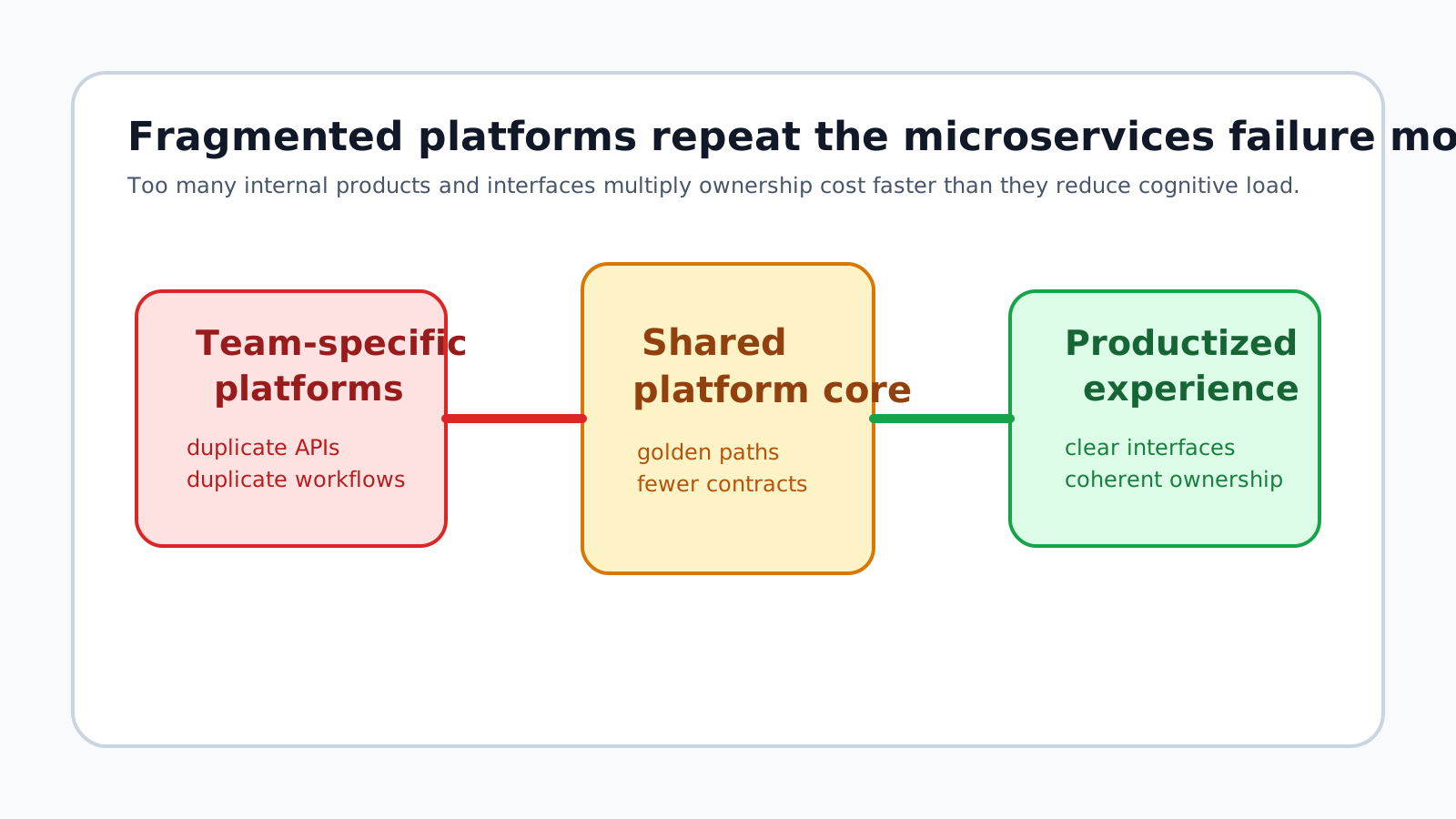
The first time I knew our internal platform was in trouble, nobody filed a bug.
People just stopped using it.
The Slack channel went quiet. Onboarding checklists stalled. The golden path we had polished for months became a “maybe later” in sprint planning.
We had built something elegant, and the org gave us the most painful feedback possible: indifference.
It felt familiar. In the microservices era, we turned “small services” into a religion, then woke up in a distributed system we were not mature enough to run.
Platform engineering is at risk of repeating that pattern. Different nouns, same mistake.
The promise we were chasing
The original promise of platform engineering is hard to argue with.
Teams should ship without rebuilding scaffolding in every repo. Environments should be reproducible. Deployments should be boring. Security and observability should be defaults, not negotiations.
Most platform teams start there. We did.
We wanted to remove friction, not add bureaucracy. We wanted to codify operational knowledge and make it reusable across teams, without forcing every product engineer to become an expert in Kubernetes, IAM, network policy, CI/CD, secrets, and cost controls.
That goal is still right.
The failure starts when platform purity becomes more important than adoption.
Why over-abstraction hurts more than you think
Over-abstraction is not an aesthetic issue. It has direct operational and business cost.
When the interface drifts too far from the underlying primitives, teams lose the ability to reason about failures. Incidents take longer. Changes feel riskier. The platform becomes something to appease instead of something that helps you ship.
I see the same failure modes repeatedly:
- Cognitive dissonance: The platform is “simple” until anything unusual happens. Then teams must learn both the abstraction and the real system.
- Internal lock-in: Escaping bad defaults becomes a rewrite, so teams stay stuck.
- Local optimization, global drag: The platform team moves faster, while product teams slow down on edge cases.
- Trust erosion: One blocked urgent fix is enough to damage adoption for months.
Microservices already taught us this: fragmentation is expensive. You pay in coordination, tooling, and operational complexity.
Platforms can recreate the same fragmentation with internal APIs, DSLs, plugins, and conventions that drift away from business needs.
The turning point
The turning point came from an incident, not a roadmap review.
A team had an urgent production issue. The fix was a reasonable Kubernetes deployment tweak. Our abstraction did not support it. The official path was “open a ticket and wait.”
They bypassed the platform instead.
In the debrief, someone said the sentence I still remember:
“I’d rather own the complexity than be blocked by it.”
That was not a rejection of platform engineering. It was a rejection of captivity.
The key insight: platforms should be boring and porous
A good platform is not a replacement for primitives. It is an accelerator on top of them.
That means:
- Boring at the core: Identity, networking, logging, metrics, deployment safety, and cost boundaries should change slowly and predictably.
- Porous at the edges: Teams need supported, documented, socially acceptable escape hatches.
Escape hatches are not a design failure. They acknowledge a simple truth: your platform cannot predict every future need.
A practical pattern that helped
We shifted from “platform as a single high-level API” to “platform as composable layers.”
Instead of forcing everything through one abstraction, we offered:
- A baseline that solves most needs with minimal ceremony.
- A supported extension model.
- A clear path to opt out for rare edge cases.
Here is a simplified layered example using Helm values.
# platform-values.yaml
global:
  observability:
    metrics: enabled
    logs: enabled
  security:
    runAsNonRoot: true
    readOnlyRootFilesystem: true
  networking:
    defaultEgressPolicy: restricted
# team-overlay.yaml
workload:
name: payments-api
replicas: 3
escapeHatches:
podSpecPatch:
tolerations:
- key: "spot"
operator: "Equal"
value: "true"
effect: "NoSchedule"Escape hatches were constrained, not unlimited. When a pattern repeated, we promoted it to first-class support.
Lessons microservices already taught us
- Complexity does not disappear. It moves.
- Standardization is not simplification.
- Interfaces are forever.
- Escape hatches preserve trust.
- Boring is a feature.
Final takeaways
- Over-abstraction recreates microservices-era pain.
- Platforms should be stable at the core and flexible at the edges.
- Guardrails should validate outcomes, not dictate every implementation detail.
- Adoption follows trust, not elegance.